

 EN
EN

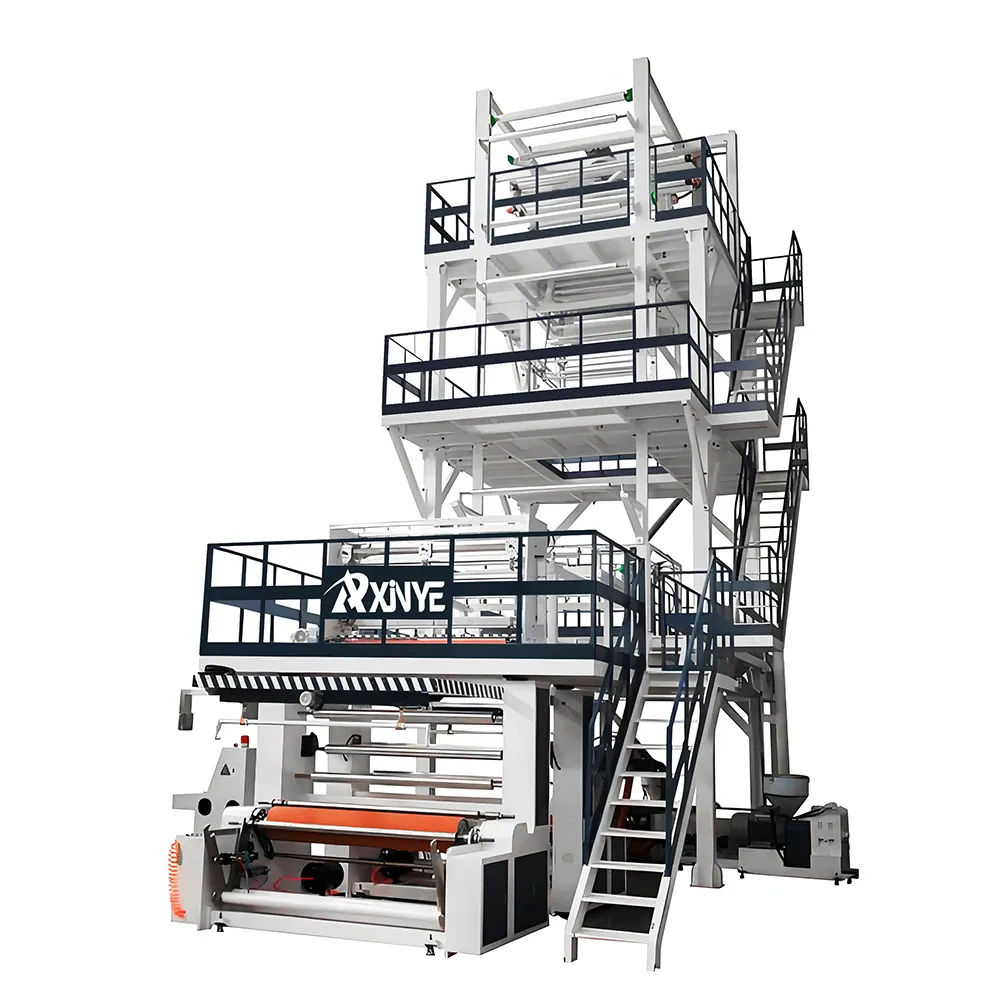
How Two-Color Striped Films Are Produced in High Output Film Blowing Machines
Understanding the Blown Film Extrusion Process for Patterned Outputs
Film blowing machines capable of high output create those distinctive two-color striped films through what's called the blown film extrusion method. The process starts when molten polymer gets pushed through a ring-shaped die to form a long tube. This tube then expands upward as compressed air fills it, creating that characteristic bubble shape. When making striped patterns, manufacturers use two separate extruders feeding different colored polymers into a specially designed die. Inside this die, there are intricate flow paths that keep the colors from mixing until just before exiting. These channels help ensure clean, well-defined stripes even as the bubble grows larger during production.
Role of Multilayer Co-Extrusion Technology in Color Layering
The multilayer co-extrusion technique lets manufacturers stack different colored polymers right on top of each other without them getting mixed together. What makes it work so well is that the melted plastic stays separate all the way through the machine until it reaches the very end of the die. This separation creates those sharp, clean lines between colors while giving operators full control over how thick each layer should be, sometimes as thin as just 5 microns or going up to half a millimeter. According to research published last year, when companies upgrade to systems with at least five extruders instead of the usual two, they see about an 18% boost in stripe clarity. These advanced machines are becoming increasingly popular for creating those eye-catching designs on product packaging that really stand out on store shelves.
Formation of Stripes: Melt Flow Dynamics and Die Design Innovations
Clear stripe definition depends on two key factors:
- Melt viscosity differential: Must remain within 12% between polymers to prevent flow instability
- Spiral mandrel design: Helical angles between 38º and 42º ensure uniform material distribution
Modern dies incorporate laser-etched microchannels that reduce backpressure by 30% (Packaging Trends Report 2024), allowing faster production speeds while maintaining pattern integrity. These innovations minimize shear-induced distortion and support stable bubble dynamics critical for consistent striping.
Case Study: Two-Color Film Production at Ruian Xinye Packaging Machine Co., Ltd.
Ruian Xinye achieved 98.2% stripe consistency using a customized 3-layer film blowing machine. The optimized configuration included:
| Parameter | Specification | Impact |
|---|---|---|
| Die gap | 1.2mm ±0.02mm | Eliminated thickness variation |
| Cooling ring type | Dual-lip external air | Reduced crystallization defects |
| Line speed | 55m/min | Maintained bubble stability |
This setup demonstrated how tight tolerances in die engineering and cooling directly enhance stripe uniformity and overall film quality.
Emerging Trends in Extrusion Dies for Consistent Stripe Patterns
The latest tech developments bring us AI driven thermal zones that can tweak die temps on the fly with around half a degree Celsius accuracy. What does this mean? Well, when materials switch out and their viscosity changes, these systems compensate automatically. Factory tests have shown this cuts down on startup waste by roughly 40%, which adds up fast over time. And speaking of changes, modern dies come with modular parts that let workers swap stripe setups in just under two hours. That's a huge improvement compared to old school methods where similar changes took about eight hours straight. Makes sense why so many shops are making the switch these days.
Maximizing Efficiency and Output in Two-Color Film Blowing Lines
Overcoming Bottlenecks in Traditional Film Blowing Systems
The old school film blowing lines tend to have problems with throughput consistency because of those pesky flow imbalances and cooling issues that just don't distribute evenly. When companies stick with outdated die designs and set their extrusion parameters wrong, they end up wasting around 15% of materials when switching colors. That's money down the drain! The newer high output systems fix all this mess though. They come equipped with these fancy melt pumps and cooling tech that actually works. These systems keep pressure stable and temperatures where they should be, so those stripes stay aligned properly even when running at higher speeds than ever before possible.
Screw Design, Motor Power, and Dual-Hopper Feeding for Higher Throughput
When it comes to screw geometry, optimizing design with deeper feed zones and shorter compression sections makes all the difference for achieving that consistent, thorough melting needed to keep colors looking right. These optimized screws work best when paired alongside those powerful direct drive motors that can handle up to around 400 kW of torque, along with dual hopper systems that measure feed rates accurately. Together they allow for constant feeding operations where output regularly tops 250 kg per hour. Manufacturers who've tested systems using 45:1 length to diameter ratio screws combined with anti surge hopper technology report seeing about an 18 percent drop in their energy bills at the same time their production numbers go up. According to recent findings from Plastar back in 2023, this kind of setup delivers real world savings without compromising on output quality.
Automation and Real-Time Monitoring for Stable High-Speed Production
The integrated sensors keep tabs on melt temps within about 1 degree Celsius accuracy while also watching those bubbles form and move around in real time. When things start going off track, automated systems tweak the die lips and adjust air ring pressures automatically to fix whatever's wrong right away. What makes all this work so well is that these machines can maintain consistent thickness levels even when running at crazy fast speeds over 120 meters per minute. Plants that switched to smart extrusion lines equipped with internet of things tech saw their unexpected stoppages drop by nearly 40 percent last year alone. The secret sauce? Those predictive maintenance warnings that pop up before problems actually happen, letting technicians address issues based on what the equipment data shows instead of waiting for breakdowns.
Data Insight: Achieving 30% Higher Output with Optimized Line Configuration
Manufacturers achieve up to 30% higher output by integrating high-precision components—such as oscillating haul-offs and multilayer dies—into standardized two-color platforms. According to industry analysis, optimized configurations lower per-unit energy costs by $12.40/ton and maintain ±2% thickness consistency across full production shifts.
Co-Extrusion Technology and Film Customization for Branded Packaging
Meeting Market Demand for Visually Distinctive Two-Color Films
Brands increasingly use two-color striped films to enhance shelf visibility and product differentiation. With 64% of packaging designers prioritizing visual impact in consumer goods (Packaging Insights 2024), high-output co-extrusion provides a scalable solution for producing eye-catching films without sacrificing efficiency or structural performance.
Combining Polymers and Masterbatch for Custom Color Layers
Color production starts when manufacturers mix basic resins like low density polyethylene (LDPE) or polypropylene (PP) together with carefully measured amounts of masterbatch to get those bright, lasting colors we see in products. Most contemporary equipment can handle around 5 percent masterbatch without compromising the material's strength characteristics. To keep things running smoothly, many plants use dual hopper systems that stop different color batches from mixing accidentally. This setup maintains product quality even when machines are running at full speed, which is crucial for maintaining consistent results across large production runs.
Precision Dosing Systems for Uniform and Repeatable Color Distribution
Closed-loop gravimetric feeders deliver dosing accuracy within ±0.5%, even at throughputs of 300 kg/hour. This level of precision eliminates common defects like color bleed or fading stripes. When combined with real-time viscosity monitoring, these systems automatically adjust flow rates to compensate for resin variability, supporting uninterrupted 24/7 production.
Case Study: Brand-Specific Stripe Films in Retail and Agricultural Packaging
The latest work on multi layer films managed to get pretty consistent stripes - around 98% accuracy actually - across more than 10 thousand retail gift wrap products. They did this by combining UV resistant orange with metallic silver layers during production. Switching gears to agriculture applications, farmers have been getting good results from greenhouse films that alternate between clear and opaque stripes. These films help spread light better throughout the growing area while still holding up well mechanically. Tests showed they kept about 85% of their original strength according to standard industry tests (specifically ASTM D882-18). That kind of performance makes them practical for real world farming conditions where durability matters just as much as functionality.
Ensuring Quality and Stability in Striped Film Extrusion Processes
Common Defects in Two-Color Films: Streaking, Misalignment, and Thickness Variation
Streaks often show up when polymer isn't flowing evenly through the die, which breaks up the continuity of stripes in the final product. When there's misalignment between the two extruders, it's usually because they're not working together properly. Thickness problems tend to happen when the melt pressure fluctuates too much during processing. The latest data from the Polymer Processing Report points out that these kinds of defects make up about 38% of all waste in two-color film production. That's why many manufacturers are now investing in better process control systems across their operations.
Temperature Zoning, Pressure Control, and Dual Extruder Synchronization
Precise temperature zoning prevents premature solidification in individual layers, maintaining balanced melt flow. Dual extruders equipped with ±1°C thermal stability and real-time pressure sensors ensure synchronized delivery. One manufacturer demonstrated that aligning extruder RPMs within ±0.5% reduced stripe misalignment by 72%, significantly improving yield.
Reducing Waste by 22% with Closed-Loop Feedback and AI-Driven Sensors
Optical sensors powered by artificial intelligence can spot tiny shifts in stripe placement down to the micron level and automatically make adjustments through closed loop systems. A recent study over twelve months showed these smart sensors cut down on wasted materials by about 22 percent according to findings shared in last year's edition of the Plastics Engineering Journal. When manufacturers link what these sensors pick up with factors like screw rotation speed, how thick the melted plastic gets, and how fast it cools down, they end up with much more consistent production runs and significantly fewer defective products coming off the line.
Strategy: Proactive Process Adjustments for Consistent Stripe Integrity
Advanced systems now leverage historical performance data to predict potential defects before they occur. Using AI models, these platforms preemptively adjust die geometry or cooling intensity, shifting from reactive troubleshooting to proactive optimization. This approach sustains stripe integrity across extended high-speed runs and minimizes operator intervention.
Selecting the Right Film Blowing Machine for Two-Color Co-Extrusion Applications
Matching Machine Capabilities to Production Goals and Output Needs
Getting the right film blowing machine means matching what the specs say with what actually needs to get done on the factory floor. Big operations that run standard plastics like polyethylene or polypropylene usually need high output machines that can push out over 500 kilograms per hour. But things change when working with those eco-friendly biodegradable materials. These plants often find they have to slow down to around 300 kg/hour or less because these special resins handle heat differently than regular plastics. According to recent industry reports from Plastics Technology in 2023, about almost 4 out of every 10 slowdowns in striped film production lines come down to equipment that just doesn't fit the job properly.
Key Criteria: Die Design, Layer Compatibility, and System Flexibility
Three factors determine success in two-color applications:
- Spiral die geometry: Dual-channel spiral dies provide superior control over color layer alignment
- Material compatibility: Matching melt flow indices (MFI) prevents delamination and interfacial instability
- Quick-change modules: Enable rapid reconfiguration in ¤15 minutes between different stripe patterns
Leading manufacturers now offer AI-assisted die calibration tools that cut setup errors by 62% compared to manual methods, enhancing both precision and uptime.
Balancing High Output vs. High Customization in Machine Selection
Operations focused on continuous production should prioritize servo-driven extruders with long L/D ratios (¥200:1), which maximize output but limit flexibility. In contrast, R&D or niche packaging facilities benefit from modular platforms supporting up to 12 different materials, despite experiencing 18–22% lower throughput.
Strategic Evaluation of Film Blowing Machines for Long-Term ROI
A 2023 analysis of 142 manufacturing sites revealed that 60% of film blowing machine ROI comes from three areas: energy-efficient drive systems, predictive maintenance capabilities, and scalability for future upgrades. To maximize long-term value, select machines with closed-loop thickness control and compatibility with ¥5-layer co-extrusion expansions.
FAQ
What is the blown film extrusion process?
The blown film extrusion process involves pushing molten polymer through a ring-shaped die to form a tube, which expands as it rises, creating a bubble shape. This method is used to produce two-color striped films by feeding different colored polymers into a specially designed die.
How does multilayer co-extrusion technology work?
Multilayer co-extrusion allows different colored polymers to be stacked without mixing by keeping melted plastics separate through the machine until exiting the die, creating sharp color lines and controlling layer thickness.
What factors contribute to clear stripe definition in films?
Clear stripe definition relies on melt viscosity differential within 12% between polymers and helical angles between 38º and 42º in mandrel design for even material distribution.
How can production waste be minimized in film extrusion?
Minimizing waste can be achieved using AI-driven sensors for monitoring stripe placement, closed-loop systems for adjustments, and using predictive maintenance to tackle issues proactively.
What should be considered when selecting a film blowing machine?
Considerations include machine compatibility with production goals, output needs, die design, layer compatibility, system flexibility, and potential for future scalability.
Table of Contents
-
How Two-Color Striped Films Are Produced in High Output Film Blowing Machines
- Understanding the Blown Film Extrusion Process for Patterned Outputs
- Role of Multilayer Co-Extrusion Technology in Color Layering
- Formation of Stripes: Melt Flow Dynamics and Die Design Innovations
- Case Study: Two-Color Film Production at Ruian Xinye Packaging Machine Co., Ltd.
- Emerging Trends in Extrusion Dies for Consistent Stripe Patterns
- Maximizing Efficiency and Output in Two-Color Film Blowing Lines
- Co-Extrusion Technology and Film Customization for Branded Packaging
- Ensuring Quality and Stability in Striped Film Extrusion Processes
- Selecting the Right Film Blowing Machine for Two-Color Co-Extrusion Applications
- FAQ